Two Sundays ago, I noticed that our wether Rudy had a cloudy, filmed-over eye. Because I look everyone over daily, I knew it was new. I checked his eye for an injury, debris, or anything else obvious, but I couldn’t find a cause. Since our veterinarian wasn’t available, I quarantined Rudy from the other goats. Then I rinsed his eye with saline and used pink eye spray while we waited for a vet to open.
I felt fairly certain we were dealing with pink eye. However, eye problems aren’t something I like to gamble with.
When Livestock Veterinary Care Is Hard to Find
Our regular farm vet is more than an hour away and couldn’t see Rudy until late in the week. Unfortunately, veterinarians who treat goats are scarce in our area. The closer options often charge prices more typical of companion-animal practices. In fact, USDA currently lists Buncombe and Haywood Counties as a veterinary shortage area for rural food-animal medicine, specifically including small ruminants.
Waiting several more days worried me. Pink eye and other eye problems can worsen, and an untreated eye injury or infection can lead to ulcers or permanent damage.
Land was only part of our decision to keep dairy goats instead of a cow. We also had to think about milk, animal size, daily work, and what our family would actually use. That is why choosing a dairy animal is about much more than deciding which animal gives the “best” milk. For us, goats fit the scale of what we need.
The Right Amount of Milk Matters
A good dairy cow can produce an impressive amount of milk. That can be wonderful if you have a large family, make a great deal of cheese, or have another good use for all that milk. For us, that amount could quickly become too much. Our goats give us enough milk to do quite a lot without moving our entire life into the dairy. We drink it, cook with it, and turn it into chèvre, mozzarella, cottage cheese, ricotta, cajeta, and other foods. Their production also gives us enough extra milk to support a small number of herd shares. That scale works for us.
Why Goat Milk?
Goat and cow milk are more alike than some internet claims suggest. However, goat milk does have differences in its fat and protein structure. Research also shows that goat milk contains relatively high amounts of short- and medium-chain fatty acids. A review available through the National Institutes of Health explains several of these differences. Some people find goat milk easier to digest. Still, it contains lactose, and people with a true cow-milk protein allergy should not assume goat milk is a safe substitute. The National Library of Medicine notes the high degree of cross-reactivity between cow and goat milk proteins.
For us, the attraction is much simpler. We like it. Fresh, properly handled goat milk tastes mild and works beautifully for the foods I want to make. I also like following the milk from the animal, to the bucket, to the kitchen, and finally to whatever happens to be bubbling, draining, or setting on the counter that day.
Smaller Does Not Mean Easier
I would never recommend goats simply because someone heard they were an “easy” alternative to cattle. Goats apparently missed the meeting where that was decided. They need strong fencing, good nutrition, hoof care, shelter, health monitoring, and parasite management. During lactation, dairy goats also need regular milking. Their smaller size makes some jobs easier for us, but they are still a daily responsibility.
That is why choosing a dairy animal should include an honest look at your household as well as your pasture. Think about how much milk you will use, how much animal you can safely handle, and how the daily chores will fit your life. The best dairy animal is not the biggest producer or the one that looks most like a traditional homestead. It is the one that fits. For us, that is a goat.
Understanding why we started a herdshare begins with our family’s effort to produce more of our own food. That journey grew through gardening, raising chickens, preserving fresh foods, and learning to replace commercially prepared products whenever we reasonably could.
Adding dairy goats felt like another natural step. However, goats require a substantial investment of time, shelter, equipment, feed, veterinary care, and daily hands-on work. Since we knew how much effort milking would require, we chose the best animals we could reasonably afford. Ellie and Nessa come from high-quality, high-producing dairy lines, making that commitment worthwhile for our family. Then they began producing more milk than we could use ourselves.
That abundance sparked the idea for our herdshare.
Sharing the Choice
Not everyone has the room, property, time, or physical ability to keep dairy animals. Even a small herd needs secure fencing, suitable housing, reliable care, and someone available every day. A herdshare gives members partial ownership in a dairy animal rather than making them customers purchasing milk. That distinction also matters under North Carolina law. The state does not allow raw milk to be sold directly to consumers for human consumption. Raw milk sold as animal feed must carry a non-human-consumption label. However, North Carolina General Statute § 106-266.35 allows an independent or partial owner of a cow, goat, or other lactating animal to acquire raw milk for personal use or consumption. For someone who does not own and care for a dairy animal at home, a herdshare provides a legal path to make their own choice about whether to use their share raw or heat-treat it themselves.
Small and Personal by Design
Our small, personal farm naturally fits this arrangement. We keep shares limited so we can protect the goats’ welfare, maintain our standards, and know the people who share ownership in our herd. Members can learn about Ellie and Nessa, see how we care for them, follow everyday farm life online, and eventually visit during member events. We want them to receive more than a jar of milk. We want them to feel connected to the animals, the work, and the farm behind it. We did not create the herdshare as a path to quick profit. Member fees help offset part of the feed, supplies, and ongoing care, but they do not come close to covering every expense or hour of labor.
Ultimately, why we started herdshare comes down to choice, abundance, and connection. It allows us to share what our goats produce while giving a few local families a closer relationship with their food and the animals behind it.
Rain does not need much encouragement to create trouble around a livestock barn. Unfortunately, we learned that lesson again this summer. Water collected in front of our dairy goat stalls, while straw, manure, and dropped alfalfa trapped the moisture underneath.
Although the surface sometimes looked dry, the ground remained soft and slick for days. As a result, every trip through the barn became an unpleasant shuffle across mud and decomposing barn debris.
More importantly, the wet ground created unhealthy conditions for the goats. Our milking does needed a firm, dry place to stand and walk. However, their hooves could not dry completely while they crossed the damp area several times each day. Prolonged moisture can soften hooves and contribute to foot rot and other hoof problems. Therefore, improving goat barn drainage moved ahead of several less urgent farm projects.
Starting Under the Stall Mats
First, Rick and I removed the heavy stall mats. Over time, the material beneath them had shifted and settled. Consequently, the mats no longer rested on a firm, level surface.
We added loose rock beneath the mats and carefully releveled each stall. Then, we reinstalled the mats over the improved base.
Because the rock allows water to move underneath the flooring, moisture should no longer remain trapped directly beneath the goats. In addition, the level mats provide a safer surface for the does to stand on while eating and resting.
The job required plenty of lifting, adjusting, and second-guessing. Nevertheless, the finished stalls immediately felt more stable.
Adding Rock in Front of the Barn
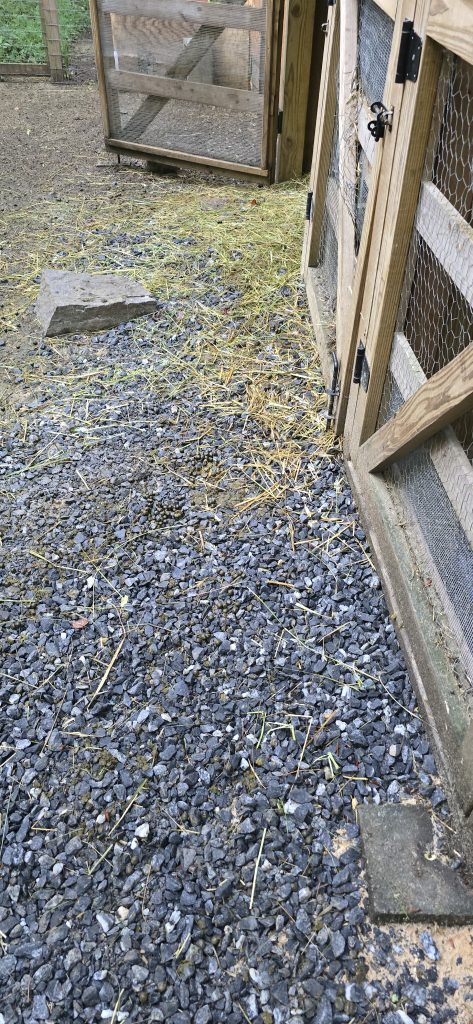
Next, we spread smaller rock across the worst area in front of the stalls. Previously, every hoofprint and boot print pressed organic material deeper into the mud. Meanwhile, each new rainstorm added another layer to the mess.
The new rock gives water space to drain instead of pooling at the barn entrance. Furthermore, it provides a cleaner and less slippery walking surface for both goats and people.
This stage of improving goat barn drainage does not solve the entire problem. However, it gives us a much better foundation while we prepare for the next phase.
Gutters and Rain Barrels Come Next
Ultimately, we need to stop roof runoff from landing in front of the stalls. Gutters offer the obvious solution, but the barn needs some preparation before Rick can attach them securely.
Once the gutters are installed, we plan to connect them to rain barrels with appropriate filters. Then, we can use the collected water to rinse barn areas or provide animal water when needed.
Additionally, the barrels will reduce the amount of water flowing toward the stall doors. They will also save us from carrying as much water down from the main spigot near the house.
Although we have experienced frequent downbursts, our region continues to struggle with drought conditions. Therefore, capturing rainwater makes sense for both drainage and future water needs.
For now, the rock has already made the barn cleaner, firmer, and easier to navigate. The project may lack polished farmhouse charm, but dry hooves and safer footing matter much more than pretty pictures.
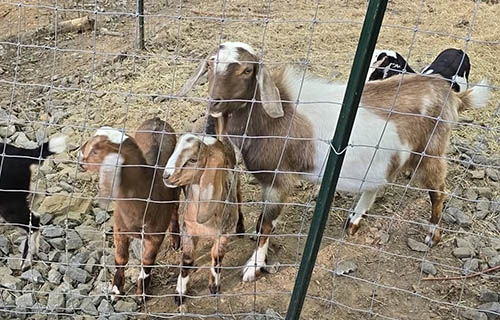
The four healthy mini bucks born this year are fully moved to the Buck Hut enclosure here on The Tart Farm now. We were able to expand this area by almost double over the last few days. A ramp and wooden lounge is also being relocated into that area to help keep the youngsters entertained.
Nessa’s kids have adjusted quickly to being in with their sire, Manny Moon. They are calmer tempered like both their parents and while energetic, not overly excitable. To my untrained eye, their form looks good, their first freshening mothers are proving to be impressive producers and they are growing well. They also have a good amount of moon spots and long pendulous ears.
Ellie’s kids, on the other hand, have had a difficult time adjusting. Despite Mama Ellie being completely over them, the boys missed their mama terribly and screamed to tell us every night. This and their ability to get into and onto anything in their paths has truly reflected their dam’s strong willed personality. Just like their mother, they are also sweet and curious.
It is going to be hard to choose which one out of these four mini bucks will be staying. They all take turns being the most annoying or lovable.